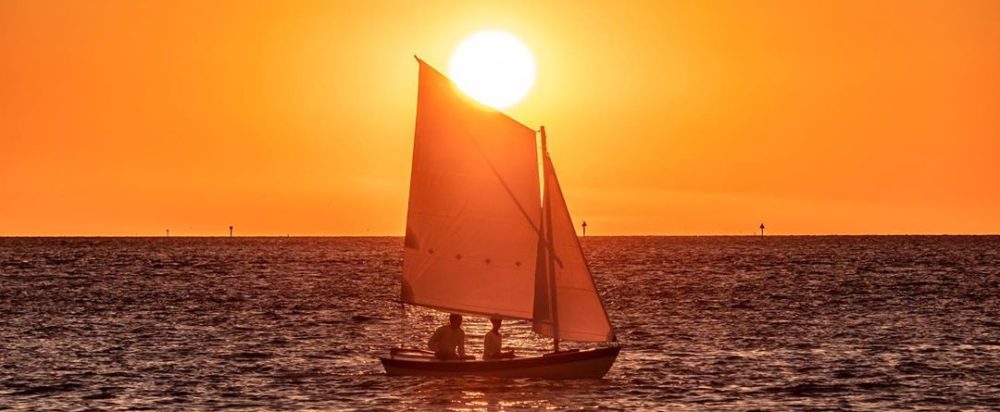
Parrott & Mosquito Islands 2020

May 16th, 2020

Saturday was forecast to be absolutely beautiful… mid 70’s and winds 5-10 knots which were supposed to swing 180º around noon. Following the age old wisdom that gentlemen never sail to windward, I thought I’d figure out an all day downhill trip.

The plan was to launch at Carter’s Creek in Irvington, sail down to Parrott Island, across the Rappahannock to Mosquito Point and around Mosquito Island. Hopefully by then the wind will shift and I’d have a run back to the ramp. I ended up going 20.5 miles in 6 hours. Average speed was 3.4mph with a max of 7.3mph.

I doubt my little economy car would do too well at this ramp, so I borrowed my dad’s F250. It drops off quickly and I did need four wheel drive to get the boat out without slinging rocks.

Tacking down Carter’s Creek. Getting off to a bad start with the not sailing to windward thing… This creek is named for Robert “King” Carter who was an incredibly wealthy colonist in the late 1600’s and early 1700’s. He was an agent for Lord Fairfax to manage the Northern Neck land grant and in the process built up an empire. He briefly served as governor of Virginia and in his will he left 300,000 acres, 3,000 slaves, and £10,000 in cash. Apparently when he died and Lord Fairfax found out how wealthy he was, Fairfax appointed his cousin as his agent instead of a native Virginian.

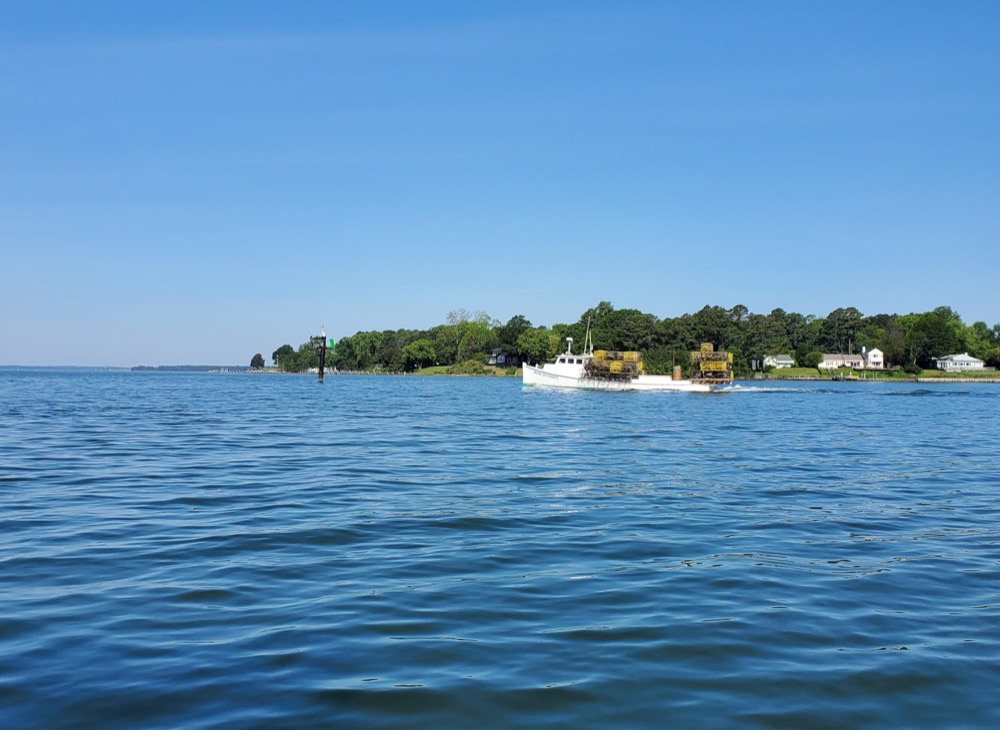
Eventually I made it to the mouth of the creek where a deadrise loaded with crab pots passed me. King Carter’s plantation is basically behind him although the house would have been to the right out of frame. Unfortunately nothing remains of the plantation… the main house burnt down during Carter’s life and according to his diaries he seemed most upset with the destruction of his wine cellar.

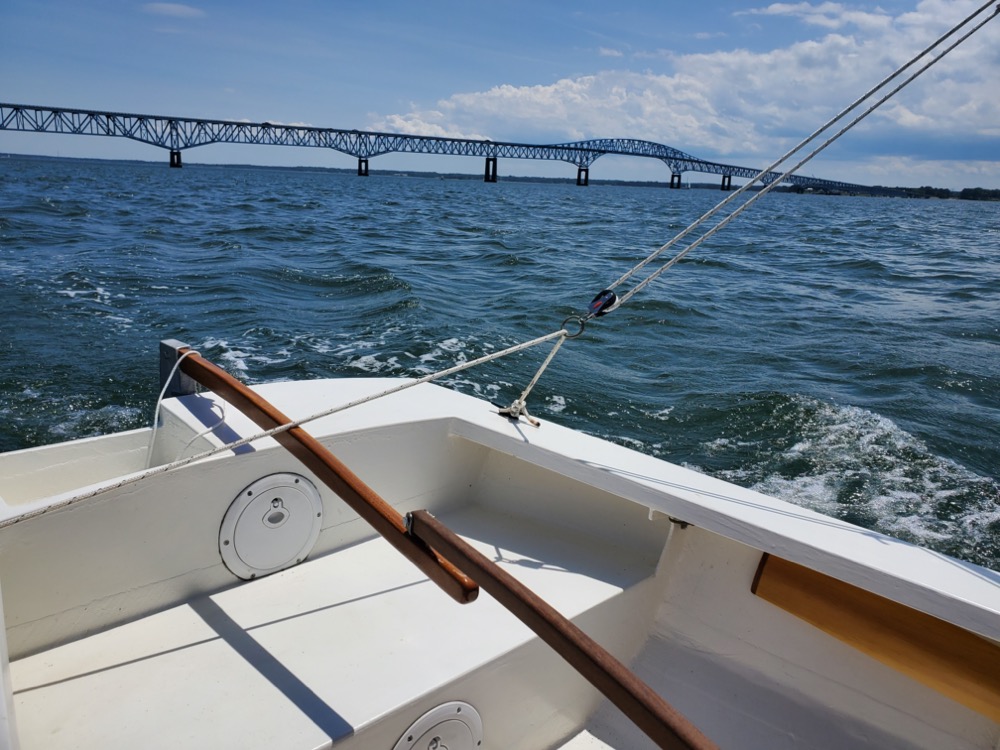
Out into the Rappahannock and heading for Parrott Island which is past the bridge on the right. I was doing about 3mph through here.

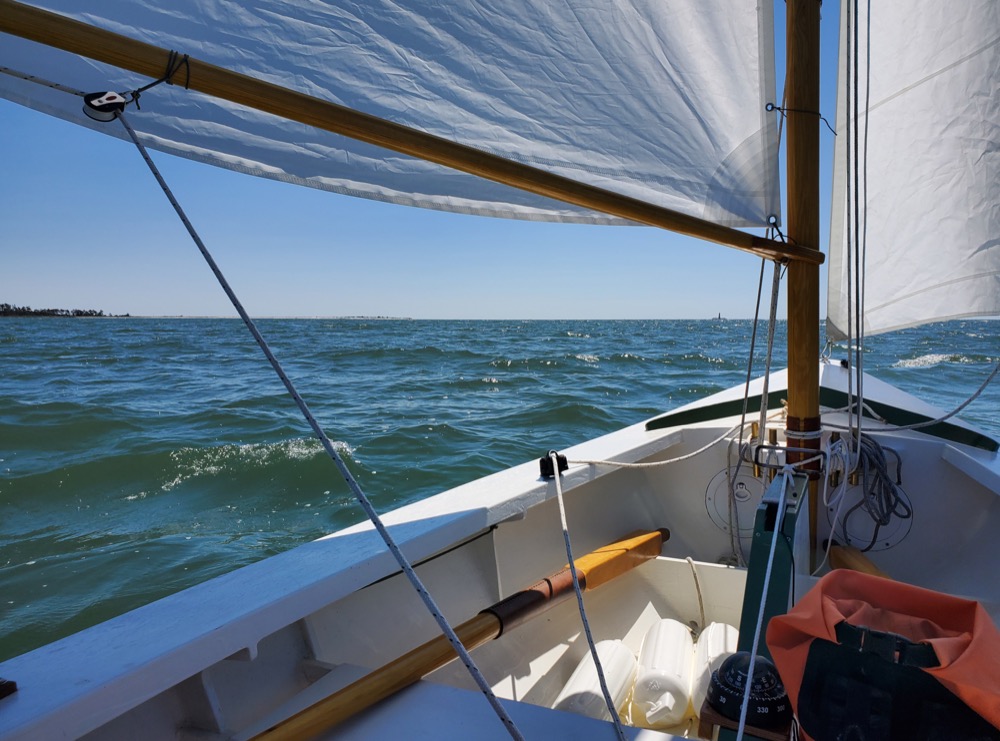
About halfway to the bridge the wind started to drop. I was still making progress though, about 1 mph which was partially the tide. I have a half baked idea for a topsail for these conditions. I’ve seen it done with sprit rigs and I think it would be an interesting experiment.

The most interesting thing happened as I approached the bridge. The wind died down enough so the water was reflective, but according to my GPS I was still making 3mph. I have added a tiller extension so I can sit closer to amidships which I’m sure helps.

Coming up on Parrott Island and the wind started picking up some. There were a lot of kayakers out and about in the shallow areas.

There’s a narrow channel marked by two rows of PVC pipe, but it was deep enough that I didn’t have to follow it.

Heading across the Rappahannock to Mosquito Point at 2-3mph. This section was marked by powerboats cutting in front of me like it was the upwind leg of the America’s Cup or floating apartments that are as tall as they are long throwing up a mountain of wake for me to bash through. And the ever present bumblebee trapped in a tin can sound of jet ski’s running around. I think I counted 12 or 13 sailboats within view, it was an absolutely beautiful day.

Coming around the back side of Mosquito Island. You might notice I’m suspiciously close to the marsh grass.

The wind changed a bit before I was expecting it to, so I had to tack my way up the narrow channel. At the very end I was trying to take a picture of the island when I ventured a little too close to the marsh and the centerboard got stuck in the mud. The bow started falling off the wind while I was getting the centerboard up so I pulled a U turn and tried again. I was surprised by how consistent the tacks were. I measured the angles and they average 93º which, from what I understand, sounds pretty good for a sprit rig!

After getting back out into the river I headed back for Carter’s Creek. For over an hour I was on a reach scooting along at 6-7mph. The tiller extension really helps with trimming the boat and hiking, but there’s a bit of a design flaw. I like sitting on the floor of the boat and when I do, the tiller extension angles down and rubs the varnish off the ~4″ of tiller I left sticking out. Not sure what I’m going to do to fix that problem.

Back at the entrance to Carter’s Creek. It’s narrow, curved, and busy. I counted six boats going through as I was approaching. Fortunately I was able to get through without too much trouble.

And tacking my way back to the ramp. Some of the funny tacks were due to wind shifts or dodging moored boats. At the end there I dropped the sails and rowed in to the dock. It’s interesting how the wind tends to shift at the mouth of creeks… I’ve noticed that every time I sail in tight quarters.


New Point Comfort 2020

April 22nd, 2020

Today I decided to take my sailboat out to the New Point Comfort lighthouse. This lighthouse was built in 1804 and used to be on a huge 100 acre island almost connected to the mainland, but it has gradually eroded away into just a tiny speck surrounded by riprap. I didn’t climb it today, but a few years ago I did after taking my canoe out to it. It was in pretty rough shape then and I’m sure it’s no better now.

The wind was forecast to be around 10mph, but either I don’t really know what 10mph wind looks like, or it was quite a bit higher. The wind was northwesterly and it was supposed to lighten up and swing around to westerly by early afternoon, but that didn’t seem to happen either. So my trip out to the lighthouse was mostly a run, while coming back I had to beat the whole way against the wind, waves, and tide. I went 23.2 miles in exactly 5 hours, averaging 4.6 mph and I hit a max of 8.1 mph. I’ve increased the frequency of the GPS points in my tracking app, so I guess that really is about the top speed of the boat. I might be able to improve it slightly once I build a tiller extension and get the trim a little better.

My GPS track of the trip.

I launched from the public boat ramp at the mouth of the aptly named Put In Creek. This creek flows into the East River which flows into the Mobjack Bay. It’s a nice ramp, although the parking is a bit limited and there’s no trash cans or restrooms.

Heading down the East River past Williams Wharf. This area has a rich history from the colonial period through the steamboat era. In the 1600’s and 1700’s English goods were unloaded and tobacco was loaded to export. In the 1800’s it was an official port of entry. In the steamboat era it was a regular stop and the James Adams Floating Theatre played shows here. In the mid 1900’s it was an oil depot. In the early 2000’s the Mathews Land Conservancy bought it and they are in the process of building a huge pubic access site. There will be a boat ramp, docks, fishing pier, nature trails, and a community center building.

Coming up on the mouth of the the East River and the Mobjack Bay. I saw four or five crabbers out checking their pots.

Looking back up the East River. Gotta remember what those houses look like so I can find the right place to turn when I come back!

Out into the Mobjack Bay! I kind of cut the corner at the mouth of the East River and it was pretty shallow. The centerboard never hit, but I could see ripples in the sand below. Fortunately the tide was rising and I wouldn’t have to worry about shallow water coming back… right? Actually I misread the tide table and the tide was dropping. We’ll see how that went when I come back. It’s probably too small to see, but New Point Comfort Light is just to the right of the point.

After making the turn into the Mobjack, I quickly shot down the shoreline. It was around in here where I started questioning Windy’s 10mph forecast. And to some extent my ability to get back. Since the wind was coming from the northwest, there’s about 10 miles of fetch. The waves were pretty steep and close together, but going downwind was smooth enough. A couple times I got the boat to surf down a wave for a few seconds which was exciting. Before I left I bedded the centerboard cap with some butyl rubber and I’m pleased to report that has stopped the leaking.

Getting closer! This is the last stand of trees on the peninsula before it turns into a long low marshy/sandy stretch. Just to the left of the woods out of frame is a wooden bird watching pier where I launched my canoe a few years ago to row out to the lighthouse.

I made it! I considered stopping, but there was 10 miles of fetch and I didn’t want to risk getting blown onto the riprap which was making a kind of scary crashing sound. Plus there are breaking waves off to the left where it gets shallow. I figured by the time I could get the sail brailed up and turned around into the wind to row, I’d be half a mile out into the Chesapeake. I’m glad I climbed it a few years ago so I wasn’t as tempted.

But I decided to circle it and call it a day. You can just make out the door on the bottom right. The riprap didn’t use to be nearly this high, but in 2012 Mathews County put these big boulders in place. There was a real worry the whole thing could wash away in a good hurricane. It’s still really exposed, but it’s probably better protected than it’s been since it was built.

Here are a few historical pictures and some I took when I climbed it in 2017:

In 1910 the keepers house and outbuildings were still standing. The water is starting to cut around the edge though.

By 1928 all that is left is the oil shed.

Nearly cut through by the 1950’s. You can just make out one wall of the oil shed which is still standing.

And here’s all that’s left today. The island is about 150′ x 150′ from an original 100 acres. This doesn’t show the longer dock that was built in 2016 to help restoration work sometime in the future.

The tower is made from sandstone blocks and stands 58′ tall. It’s in pretty rough shape. It’s interesting how 200+ years of sand blowing around has weathered the lower blocks way more than the top. When my wife and I landed we must have scared off 50 pelicans… everything was covered in bird poop and smelled like rotting fish.

I didn’t expect it to be open when I arrived, but somebody has ripped the lock out of the frame. There were no posted signs, so I started for the top! You can see how much the island has been built up to keep it from flooding.

Sandstone steps. There’s no handrail and you really need to be close to the wall to have enough space for your foot.

After 50 steps you make it to a wooden landing that looks to be pretty new. There’s a rusty ladder made from angle iron that leads up into the lantern room. One of the rungs has rusted through, so it’s a little sketchy.

There’s a tiny door to the balcony which is about 3′ tall and 2′ wide. Everything is rusty and covered in bird poop. I walked out onto the balcony and the railing wiggled enough that a good shove might rip it right off.

The steps are covered in loose stones and twigs that birds have brought in.

My wife took this picture of me at the top. Proof that I was there haha.

And back to today’s trip…

After rounding the island I started tacking back home. I pretty quickly found I had to sit on the rail to have any hope of keeping the boat upright. I’m not sure what the windspeed was, probably 20-25mph according to the Beaufort scale. I really need to figure out reefing… but it’s tough with a sprit rig. I’m thinking maybe drop the jib, then scandalize the main might be easier than trying to lower the snotter and tie in reefs. I really should practice sailing with just the main to see how it works.

This is the only picture I took until I made it back into the East River. It doesn’t look too bad, but there were a lot of whitecaps and the waves were short and steep. They seemed to be spaced about 1.5 boat lengths apart which made for a rough motion. A couple times a wave hit the side of the boat and covered me in spray and at one point a whitecap nearly broke into the boat. Fortunately she just slid up overtop of it. Looking at my GPS track, I lost about 50 feet every time I tacked, and sometimes it took a few tries to get through the wind. But when I was moving the boat averaged around 4.5-5mph.

I tried to cut the corner since I thought the tide was rising and I made it through on the way out, but I soon started hearing my centerboard bumping along the bottom. I couldn’t point up any higher and I really didn’t want to tack back into the Mobjack if I could help it. The water was quite a bit calmer through here, so I pulled in on the main sheet and used my balance to keep the leeward rail underwater. For nearly half a mile I kept the boat heeled over which kept the centerboard from hitting. Those side decks come in handy again!

Even though the water was calm compared to out in the Mobjack, tacking up the river back to the ramp was the trickiest part of the day. I’d get hit by sudden gusts of wind that would nearly put the rail under, then the wind would die just as suddenly and I’d nearly fall off the windward side from hiking. But I eventually made it back to the ramp and got the boat hauled out.

I guess the day went too well to get off without a minor disaster! Coming home I felt the trailer start to sway a bit and when I looked through the side mirror I saw a few chunks of rubber coming off. This tire was really old and starting to dry rot and I was thinking I should probably replace it. It took about 20 minutes to put the spare on and with that today’s adventure was over!


Centerboard Catch

Another improvement I’ve made is a 316 stainless steel catch and protective pad to hold the centerboard in the up position. I welded it from some 3/16″ x 1″ flat bar and 1/4″ round bar. I countersunk the mounting holes on both sides, one for the #8 screws and the other side for a wad of butyl tape. Previously I looped the line on the handle around the centerboard pivot bolt which was awkward at best.

Wolf Trap 2020

April 11th, 2020

Today was forecast to be a really nice day, so I decided I’d try again to make it to Wolf Trap light from Gwynn’s Island after my previous attempt was cut short by some serious fog. I’ve also made a few improvements to the boat which I wanted to test. I epoxied in two additional belaying pins and welded up a stainless catch for the centerboard rod.

I won’t keep you in suspense, I did make it and here’s my GPS track. It was a 21.1 mile trip!

All loaded up and ready to head to Gwynn’s Island. I get some strange looks when I pull in at the boat ramp beside a row of lifted F250’s pulling 300hp center consoles. Clearly I’m in the wrong line of business.

I launched right at low tide and I was a little worried I wouldn’t be able to get to Rigby Island since it’s so shallow. Fortunately I could rely on a rising tide throughout the day and hopefully a boost on the return trip.

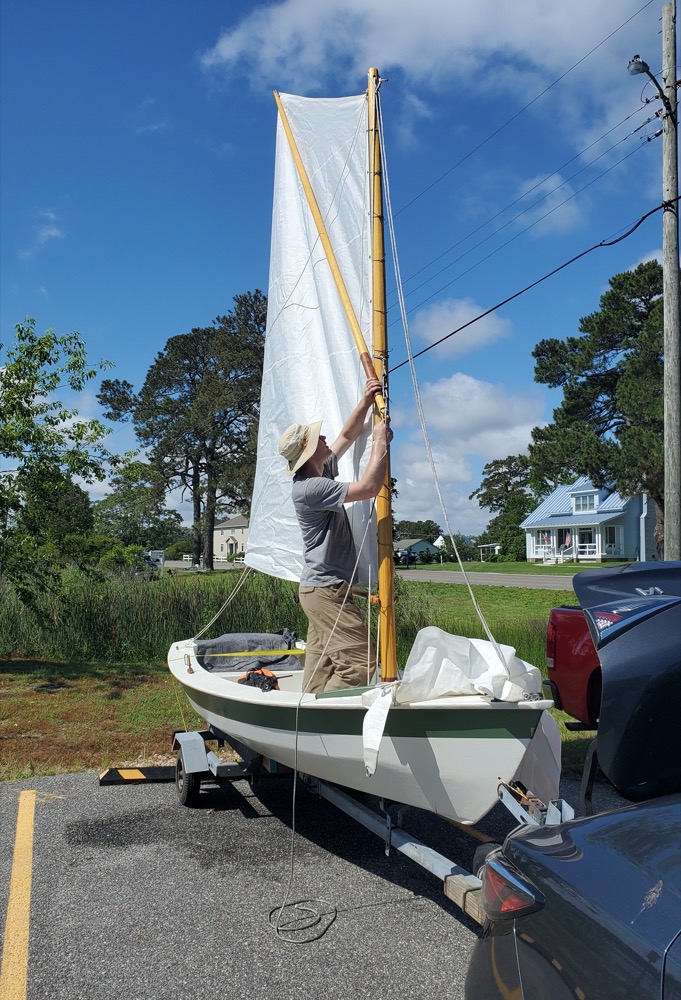
This time I did a better job of brailing up the sail. I think some bungie cords might be easier to use rather than wrapping the brail line around everything. I’m starting to get better at getting everything rigged and launched without incident. From arriving to launching took 40 minutes.

Heading away from the ramp on a run. My mother was a postmaster on Gwynn’s Island and she’s told me stories of how that swing bridge would sometimes stick open. One time it jammed just before a hurricane arrived and she was worried she’d have to stay in the post office. But fortunately they got it closed again.

Towards the bottom of Gwynn’s Island I saw a number of watermen checking crab pots. Growing up I used to think I wanted to work on the river, but I bet the freezing cold or sweltering hot days would outweigh the nice days.

Heading towards Rigby Island. It was somewhere along in here where I heard an unwelcome grinding sound emanating from the centerboard. The boat speed also seemed to take a hit. Looks like I was running out of water! I need to get a jam cleat and mount it to the centerboard cap for the downhaul. Currently I just tie the line around the thwart, but that makes it hard to get the board up in a hurry.

The sandy part of the island is so low that I was having a hard time seeing it and I strayed into a shallow area. I made a turn towards shore because most of the houses had docks, so I assumed there was deep enough water.

There are a lot of sandbars in this area and with the low tide they were just barely submerged.

Navigating by the color of the water. The sandbars seem to be pretty sharply defined though.

Heading out into the bay. I found a row of PVC pipes marking a channel between islands so I followed it out rather than follow the shore further south.

There’s Wolf Trap light on the horizon! It’s a little over 5 miles away. As I got away from shore the wind started picking up. The waves were the biggest I’ve had the boat in, maybe 3′ at times but the majority were probably 2′. At one point I had waves coming from two different directions and the wind from a third… so it was an adventurous trip. The boat really handled it well.

Eventually I made it to the lighthouse. I wanted to circle it, but the wind shifted so I’d have to beat directly towards it. Everything was making me start thinking about heading back, so I decided to turn around. Maybe another time. These pictures really don’t do the waves any justice.

Aiming at what I thought was Stingray point just north of Gwynn’s Island but it turns out that was actually Windmill point. I was a little over 20º off of where I should have been going.

After checking my phone I realized I was about to miss my exit.

Heading through the hole in the wall wing and wing. Despite being ~30 yards wide in places the channel was well marked. I’ve been thinking about making a tool that is a combination whisker pole, boat hook, and mounts to the rudder head to support a tent’s ridge line.

Nearly back to the ramp. I went 21.1 miles in 5.5 hours with an average speed of 3.9mph and a max of 6.8mph. I think I need to get my GPS tracker to take more finely spaced points. It’s currently set to take a point every 2 seconds, but I can’t believe 6.8mph is the max I hit today.


Winter Improvements

Sailing weather is coming soon and I’ve been working on some improvements to the boat. I reshaped and leathered the boom/boom jaw connection so it doesn’t chip the varnish off the mast. I also added a little hook to the mast to keep the snotter from sliding down which puts a diagonal crease in the sail. http://sailingmoga.com/spars/

With the boom fixed, I tested the brail line to see how well it works. It’s ok, but there’s still room for improvement. http://sailingmoga.com/brail/

I’ve also been busy varnishing the brightwork and painting over the chips in the paint job. Exterior latex was a bad choice… Someday I need to figure out how to get it all off and redo it with some epoxy paint or something more substantial.

Gwynn’s Island 2020

Gwynn’s Island 3/29/20

I’ve slowly been making improvements to my boat over the winter and today, in the interest of our national wellbeing, I decided to practice some social distancing out on the water. And as a completely unrelated benefit, I got to test how well my improvements work.

Previously, every time I’ve launched I’d get blown into the dock while trying to rig the sails. It’s been frustrating and I finally decided to rig a brail line that bundles everything up into a neatish package. My plan is to rig the boat in the parking lot, brail up the sail, and launch the whole thing ready to go. Then I can row out to deeper water, let the sails down and start sailing. Hopefully this will improve the lifespan of the paint on my gunnels.

Now that spring is finally here, I’ve been watching the weather looking for a nice day. The water is still ~50º, so I wanted easy wind, nice air temperatures, and a protected area to sail. Today was forecast to be 10-15mph wind and 80º temperatures, so I set out to a nearby boat ramp on Gwynn’s Island. This island offers a 2.5 x .5 mile strip of water that is ideal. One note if you ever go to this ramp… there are power lines across the parking lot, but there’s plenty of room to maneuver around with the mast up.

My general plan for the day was to sail to the southern part of the island and if everything was going well, continue on to Rigby Island which is all that’s left of a whole line of sandy barrier islands that stretched south. I wanted to scope it out as a potential stopping point on some future camp cruising adventure. After Rigby Island I would consider sailing out to Wolf Trap Light, assuming the conditions were good. Wolf Trap Light is caisson lighthouse about three miles off the coast. From what I’ve been told, the HMS Wolf ran aground there in the late 1600’s, so I guess it’s a Wolf trap! After returning from the lighthouse, I’d take “the hole in the wall” which is a narrow channel between the sandbars that used to be barrier islands. I figured this would give me a good opportunity to practice aiming for a precise location and trying to find it with little in the way of landmarks. The entire trip would be about 20 miles.

My planned path.

However, even the casual observer will quickly see by my GPS path that I didn’t quite make it. Best laid plans…

GPS track

It turns out the warmer air brought a ton of fog because the water is still cold. Advection fog it’s called according to Wikipedia. The 80º weather and 10-15 mph wind didn’t quite make it, although it was a nice 70º day.

Anyway, I got to the ramp around 10am and started rigging the boat in the parking lot. It took about 30 minutes, but I did have some trouble with the brail line tangling up which required me to raise and lower the sail a few times. But eventually I got everything sorted and got the boat launched. Based on the conditions, I’m pretty sure the passerbys thought I was a fool.

The bundle could be neater, but it worked well. The framing could be better too… Totally didn’t notice the reflection in the water when I took the picture.

I rowed out a bit, dropped the sails and rigged the sheet. Much better than trying to do it while banging into the dock! The next problem was the rather concerning lack of wind. There was just a hint of breeze and I started heading towards the bay. I soon began wondering why the boat seemed to crab across the water when I realized I’d forgotten to put the centerboard down. That helped things considerably.

I drifted and sailed along for a little over an hour, in and out of the wind shadow of the island. Things would pick up as I came to the mouth of a creek, then slow down when I was closer to land. I tried every light air dinghy sailing trick I knew, although that was limited to sitting on the leeward side and the occasional wiggle of the rudder to see if that made any improvement. I thought about the oars, but this is my yacht and I’m a proper yachtsman, not some galley slave! Eventually I resigned myself to watching nature go by. Ducks paddled away, a pair of Canada geese honked as they changed course for me, an osprey flew by with a stick, fish splashed out of the water, a waterman cussing his outboard echoed out of the mist.

A pair of ducks that seemed a bit alarmed by their sudden change of pace.

Towards the bottom of Gwynn’s Island I watched a ripple of wind coming and the sailing picked up. Once I was out of the wind shadow of the island the boat speed increased to 4.5-5mph which was a welcome change. It’s nice hearing the gurgle of water and seeing a trail of bubbles off the transom.

The fog that was supposed to burn off before I even arrived at the boat ramp was still hanging around and there wasn’t much to see, so I started following lines of crab pots.

For a while the fog was getting lighter, but it soon changed to thicker than when I left. Before I could see 4-5 crab pot floats, now it was down to 1 or 2. I made the executive decision that if things hadn’t noticeably improved by 12:45 I’d head back. Not because I had any misgivings about the boat, just that it was getting a little boring seeing just a patch of water and then nothing.

The theme from Master and Commander started playing in my head.


Shortly before my self imposed deadline a buoy materialized out of the fog. This is the buoy that marks “the hole in the wall”. I decided that this was a decent accomplishment for the day and I’d turn around here. On a side note, I need to do something about all the lines up by the mast. I think I’m going to add two more belaying pins because currently I have two or three lines per pin and it’s a bit of a mess.

On the return trip I decided I’d try to steer straight runs with the compass, then check the GPS track and see how I did. I did a 180 and headed back to the ramp. So far navigating has been with Google maps on my phone to get an idea of where I am, and then trying to hold a course with the compass. It worked ok and I never felt like I was lost. Also I’m happy to report that my little hook to hold the snotter is working great and I no longer have creases in the sail.

After a while I started seeing trees in the fog and found my way back to the ramp.

By this point the wind had picked up and brailing the sail while on the water was a little exciting. But it worked ok and I rowed the boat back to the ramp. After pulling the boat out and getting everything unrigged, the fog started to lift. Go figure!

I recorded my GPS track to analyze. I averaged 3.6mph, had a top speed of 6.1mph, and spent nearly 2.5 hours on the water. The entire trip was 5.6 miles. I’m not good at estimating windspeed, but if a nearby weather station is to be believed, the wind was somewhere around 5 knots. Steering a straight line with no landmarks was harder than it sounds, but in my defense I was taking pictures. At least that’s my excuse and I’m sticking with it.

So while I didn’t accomplish anything I set out to do, I did confirm the brail line setup is the way to go and I got a lot of confidence navigating in fog. I never once felt uncertain about the boat’s capability which is turning into a welcome theme every time I take it out.

Brail Line

Today I added a page about my experiments with adding a brail line to the sail. I’ve also added a section to the menu at the top for some of the finer details of the boat. This will house pages for stuff that’s a little more specific and in depth than the stuff in the building drop down.

Hello world!

So I’ve got some time off for Christmas and I decided I should make a website to document my homemade sailboat and related travels. This project is just too big and wide ranging for a single page on my personal website, so I guess I’m now a blogger!

I’ve added a few sections at the top. One section for all the building pictures separated by category, and another for trips. So far I’ve only done short day trips, but if I do longer adventures, I might make a new section to house those articles.

I started building Moga in May of 2018, and launched her in June of 2019. I didn’t work on it much during the fall and winter as I was hunting or it was cold, so maybe 8-9 months of work.

Rappahannock 2019

Rappahannock 10/28/19

I’ve had Moga completed for about six months, but before today I’ve only had it out three times on a vacation and that was just for pleasure sailing. For a while I’ve wanted to get hard data on how the boat performs so I can better plan some camp cruising adventures for next summer. Today seemed like a nice day, possibly one of the last opportunities of this year, so I set an out of the office auto email and went sailing.

In my rush to get the boat ready for the vacation back in May, there were a lot of odds and ends that didn’t work all that well but weren’t bad enough to prevent me from using the boat. So I had a few days of repairs to do and then I re-rigged everything to make sure it all works. Furling the sail around the sprit works pretty well, but a brail line has shot to the top of the new list of things to improve.

I probably look ridiculous and my mileage drops from 44 mpg to about 28. Fortunately I don’t have to go far.

Launching Moga at a nice boat ramp on Windmill Point at the mouth of the Rappahannock River.

Here’s a satellite view of the area and my track for the day. You can see the marina at the tip of Windmill Point that I launched from. I grew up sailing around here in a 70’s era Sunfish I bought with grass cutting money. Making day trips to Parrott island, Mosquito island, and Grog island or just around the bridge and back was how I’d spend summers. Sadly, Grog island has washed away and is no more.

And here is the data I collected. GPS track, speed vs time, wind speed and direction, and tide. The winds started out pretty blustery in the morning, but they were down to 10-15 by the time I launched at 10am. Then later around 6pm pretty light to nonexistent. My total trip was 32.7 miles in just under 8 hours.

From the GPS track I calculated tacking angles as best I could. The wind was pretty light on the return trip and the better tacks were when the wind picked up. I have no idea whether these are good, bad or indifferent. The 122.77º tack was when I had a terrible crease in the sail though. Making the snotter and downhaul run back to the cockpit is also high on the list of improvements.

Blasting up the river on a broad reach. I had both the main and jib up, so just over 100 square feet of sail. Probably too much, but fortune favors the bold I suppose. For over an hour I averaged 6.5-7mph with a peak of 8.7mph. A few times a gust put the rail under, but the side decks gave enough margin that I could let the sheet out some. The extra wide rub rail that gave me so much trouble when I built the boat turned into a handy spray deflector. It was satisfying to see the water coming up the hull forced out nearly horizontal. Surfing down waves was pretty fun, although I’m still sitting too far back. A tiller extension makes it onto the list.

Approaching the bridge. Things have calmed down quite a bit since the bigger waves closer to the point. Still doing 6-7mph.

About a mile past the bridge the wind drops out and stays shifty. A small sailboat ahead of me takes down her sails and motors for Carter’s Creek, but turns around and comes over to me to get a look. The skipper gives me a thumbs up and heads back. Credit to Ross, every time I’ve had the boat out someone has given me a compliment. Later I briefly tried to go wing and wing, although the jib didn’t want to stay out. Should have used an oar to boom it out, but didn’t think to.

I make a wide sweeping turn across the mouth of the Corrotoman and start tacking upwind. Hopefully the tide change is helping me. I’ve got a pretty bad crease in the sail, so I try heaving to and adjusting the snotter tension. Heaving to works pretty well and I get the crease out, although fixing the crease would become a theme. I need to figure out where the snotter should live and epoxy a little thumb cleat onto the mast so it can’t slip down. And run the line back to the cockpit.

Little known fact, cardboard boxes are the epitome of high class yachting.

See the line of cars? Traffic is eternally stopped on this bridge. Two years of painting the superstructure (which still bleeds rust), a year of repaving, and annual month long inspections. Back in the 90’s they redid the deck by removing a section and you had to drive over the hole on these big steel humps. Like a little bridge on the bridge.

By this point things were getting a bit old. What little wind there was had shifted to directly where I wanted to go, and I had about two hours of sunlight left. I was pretty sure I wouldn’t have time to sail back to the point, so I did the unthinkable and lowered the rig to start rowing. The long straight section between hour 6 and 7 was me rowing at about 4mph. I definitely had some help from the tide though, so maybe actually 3-3.5mph? Anyway, the wind started to return a little, so I put up the rig. Unfortunately, the loop at the peak of the sail came undone and dropped into the water, so I had to sail with it scandalized for a while until I could make a new loop of line. That explains the track, no drinking I promise! The sun was getting low, so I decided to head for a friend’s house and leave the boat docked overnight. No pictures of this section as I was kinda done.

So there it is, the first data gathering sail over a fairly long day sail. Hopefully next spring I’ll do some more of these to get a better idea of the boat and its capability. I will say that this trip reinforced my opinions about it from sailing it during vacation. I think it’s a super capable boat and my sailing ability is the limiting factor.

10/29/19

The next day I motored the boat five miles around to Windmill Point. Steve (the guy who helped me fiberglass the hull) also brought me a British Seagull 40 Plus he had but never used. Today was the day to put it to the test so I first gave it a thorough overhaul. I cleaned the spark plug, changed the lower unit oil, and mixed up some new gas for it as it’s a two stroke. These engines take an eye watering 10:1 ratio, but I am running biodegradable oil and plan to convert it to 25:1. I wrapped the starting rope around the flywheel and gave it a pull. The engine roared to life and I let it run for about 10 seconds before cutting it off. Steve says he last started it 3 years ago, so I guess it’s true these little engines are indestructible.

Anyway, I mounted the engine on the boat’s transom and got rid of the excess sailing accouterments before leaving my friend’s dock.

Sailing dinghy converted to motor boat!

After getting the engine mounted and fired up, I took off. These engines are direct drive, so you need to be pointed in the right direction and ready to go. Everything went fine for seven minutes when the engined started losing power and then sputtered to a halt. I wrapped the starting cord around the flywheel and go it going, but it soon died again. I kept this up for two or three more times before I realized I’d forgotten to loosen the gas tank vent. A vacuum was building up and fuel wasn’t draining properly into the carburetor. With that issue fixed, it was smooth running all the way to the boat ramp.

Smooth running once I loosened the gas tank vent.

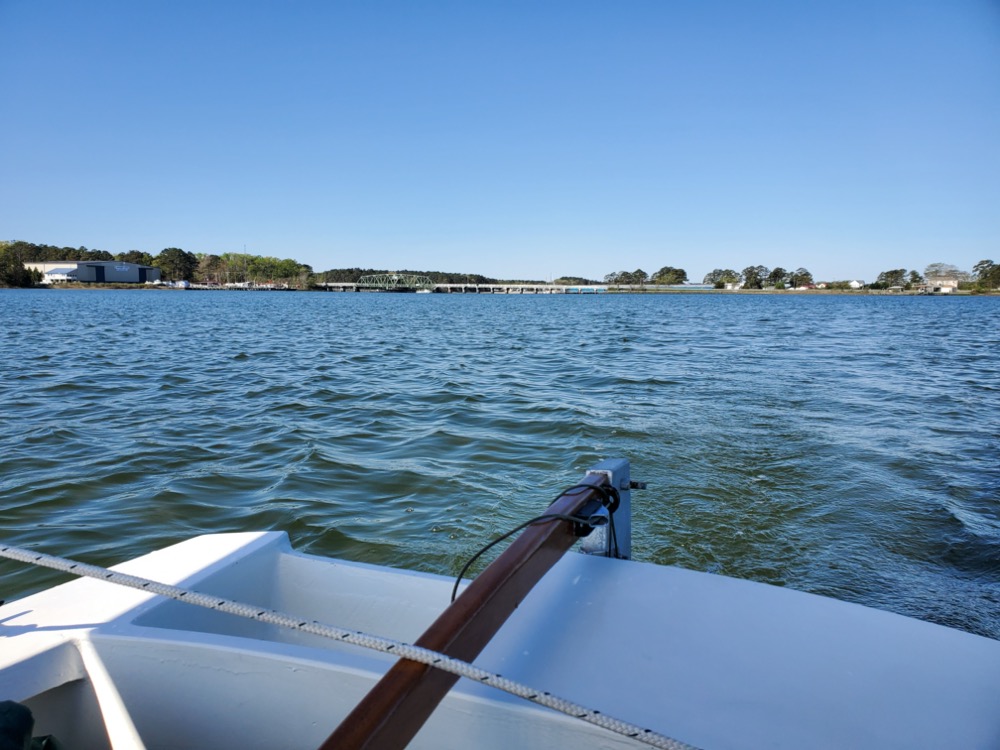
The next issue to sort out was the boat’s trim. I had to sit relatively close to the stern to reach the motor’s tiller. This put the bow up rather high and made the stern squat down in the water which causes a lot of drag. So I lashed an oar to the tiller as best I could and sat up on the main thwart. The boat balanced much better, although I couldn’t tell much difference in speed. I also played with the throttle a bit so it wasn’t an apples to apples comparison.

Impromptu tiller extension. I need to make something that will fit inside the hollow tiller arm.

As I approached the boat ramp I had one last issue. When I tilted the motor up, it started leaking fuel into the motor well. It turns out I’d forgotten to tighten the fuel tank vent and should have let the carburetor bowl run dry. Oh well, next time I’ll be prepared. So with that my trip was officially complete.

Graph of speed vs time

Wide open, the engine pushed the boat about 6mph. At slightly less than full throttle it was more like 5.7mph. My boat is 15′ long, so its hull speed should be 5.8 knots, or 6.67mph. Of course my bow isn’t plumb so the waterline length is a little less, so I’m probably going about hull speed. At a certain point more throttle just means more noise, so it’d be interesting to see what the most efficient throttle setting is.